Home espresso means making coffee the café way in your own kitchen, without the queue or the counter. Choosing between the types of espresso machine on sale is choosing how much of the craft you want to do yourself. Get that choice right and you can make a latte at home that tastes like it came from a café.
Baristas brew coffee at home too. What they choose is a useful guide for everyone else, since people who make coffee all day already know which features change the taste and which only change the price. The best home espresso machine for you depends on how much control you want over each cup.
How A Home Espresso Machine Makes Coffee
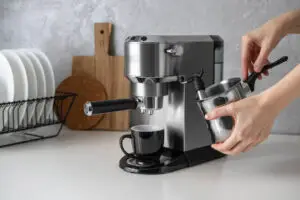
A home espresso machine makes espresso coffee the same way as the equipment in coffee shops. A pump forces hot water through a tightly packed bed of finely ground coffee at roughly nine times normal air pressure. The process is called espresso extraction and it finishes in under half a minute. The result is a small, strong espresso shot topped with crema, a layer of tan foam.
A boiler supplies the heat. Espresso brews best just below boiling point and small swings in brew temperature change the taste from sweet toward sour or bitter. Cheaper home machines let the heat drift between shots while models with PID temperature control, an electronic thermostat, keep the water within about a degree of your chosen setting. That stability is the difference between a result you can repeat and a lucky one.
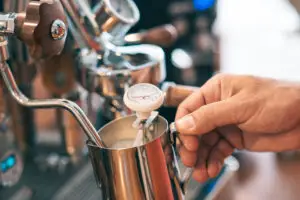
A latte, a cappuccino, and a flat white are all espresso and milk in different ratios. To steam milk, the machine heats water past boiling point and pushes the vapour out through a metal steam wand. Single boiler machines have one tank at one temperature at a time. Brewing and steaming happen one after the other, with a wait in between while the water reheats. Dual boiler machines keep one tank at brew temperature and a second at steam temperature so you can brew the shot and steam the milk at the same time.
Manual Espresso Machines
Manual espresso machines strip home espresso back to a lever, a piston, and your own effort. Instead of a pump, a lever or a piston moves the water and all of the pressure behind it is yours. The taste of each cup follows from that pressure. That is the appeal for home baristas who want full control over every stage of a shot of espresso.
Every mistake made on a manual espresso machine ends up in the cup. Pressing too hard, too softly, or too unevenly changes the shot and no electronics are there to even it out. Output is also limited to one small drink at a time. If speed is the priority, look at pump-driven machines instead.
Semi-Automatic Espresso Machines
Semi-automatic machines split the work between you and the electronics. The machine controls the pressure and the heat while grinding the beans, packing them down, and timing the shot stay with you. That balance gives you room to improve without needing perfection on day one.
Breville machines with a built-in grinder pack the whole process into one bench footprint. The Breville Barista Express and the Breville Barista Pro both grind and brew from one body, which keeps cost and clutter down for a first setup.
For home users serious about espresso, dual boiler machines are where home espresso comes closest to the gear behind a café counter. The La Marzocco Linea Mini is a scaled-down version of the commercial machines the company sells into the hospitality trade. Rocket Espresso builds machines for home benches with the same style of parts as its café range. The Meraki espresso machine is a newer dual boiler machine that builds the grinder in as well. The extra money at this level buys temperature stability rather than extra buttons.
Automatic And Capsule Machines

Automatic espresso machines do the whole job of home espresso at the press of a button. They grind the beans, press them flat, and brew the shot without you touching anything, covering every step a barista would otherwise perform. Some models steam the milk as well, which makes them the fastest route to a variety of coffee drinks at home.
Capsule machines remove grinding altogether. Each pod holds a sealed dose of ground coffee, ready for hot water and nothing else. A capsule espresso maker is the simplest home coffee machine to own because there is nothing to measure, nothing to clean out of a grinder, and nothing left to practise. What you give up is the ability to change how the coffee tastes, since the pods only come in the blends the manufacturers choose to sell. For anyone who wants espresso at home without the craft, that trade is an easy one.
Pairing A Grinder With Your Espresso Machine
A home espresso machine only brews as well as the grounds that go into it. Brewing espresso calls for coffee ground fine and ground evenly, because the grind controls how fast the water passes through and how much flavour dissolves out on the way. If the grounds are too coarse, the shot pours fast, thin, and sour. If they are too fine, the flow slows to a bitter trickle. Even the best coffee machine cannot fix an uneven grind.
Burr grinders crush the beans between two cutting surfaces to one even size while blade grinders chop them into a mix of fine dust and coarse chips. An uneven mix gives the water fast paths and slow paths through the coffee. Part of it then over-extracts into bitterness while another part stays sour and underdone. A quality coffee grinder is part of the cost of the setup rather than an optional extra. Give it the same scrutiny as the machine when you price up your coffee equipment.
A built-in grinder keeps everything compact while a separate coffee grinder gives you finer adjustment and can follow you to your next machine. Matching the grind to your setup is called dialling in and it is a skill you can practise with every new bag of coffee beans. The best espresso a machine can make still depends on that stage, before any water moves.
Coffee Making Training For Home Espresso
No machine tastes the coffee it makes. Judging the result and correcting the next attempt stay with the person holding the cup. That judgement is the part of home espresso a purchase cannot supply and it comes far faster under instruction than from failed shots alone.
Our coffee making training puts you behind commercial equipment with trainers who watch you make espresso and correct your grind, your milk, and your pour on the spot. You can practise until a flat white comes out the way you pictured it and then bring the same technique home to whichever of the espresso machines of 2026 ends up on your bench. Enrol in coffee making training and you can make great coffee at home without the guesswork.
FAQs
What Is The Difference Between Espresso And Drip Coffee?
Drip coffee makers let hot water fall through loose grounds under gravity alone while an espresso machine forces it through packed grounds under pressure. Espresso comes out smaller, stronger, and quicker as a result.
Do Espresso Machines Need Filtered Water?
You can fill the tank straight from the tap. Water high in minerals leaves scale inside the boiler over time. A filter jug keeps the worst of it out if your tap water leaves a white crust on the kettle.
Do You Need Special Beans For Espresso?
Any beans can be brewed as espresso and bags labelled as espresso roasts are simply blends made to taste balanced under pressure. Whole beans keep their flavour longer than pre-ground bags. Buy whole and grind them just before brewing.
How Should An Espresso Machine Be Kept Clean?
Wipe the steam wand straight after each use, before the milk bakes onto the hot metal. For the rest of the machine, follow the cleaning and descaling schedule in the manual. Descaling, a flush with a cleaning solution, clears mineral build-up out of the boiler before it blocks anything.